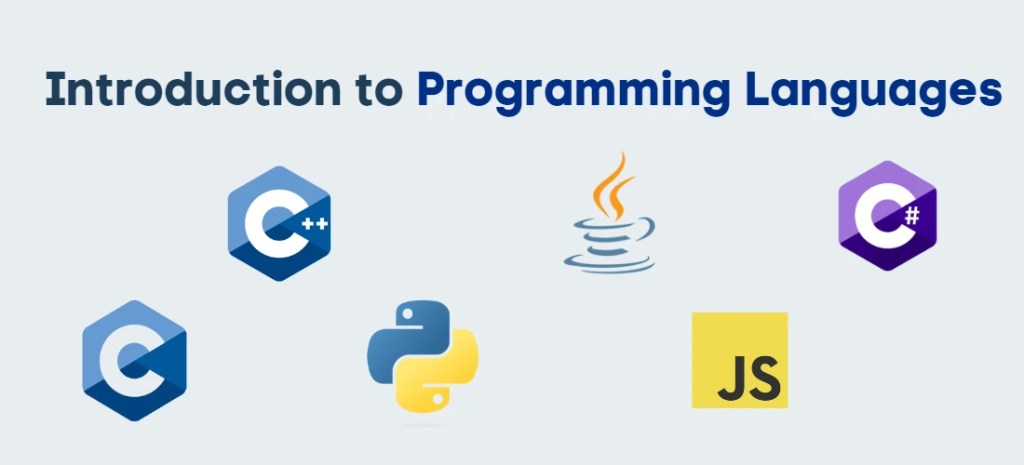
A programming language is a formal language that specifies a set of instructions for a computer to perform specific tasks. It is used to write software programs and applications and to control and manipulate computer systems. There are many different programming languages, each with its own syntax, structure, and set of commands.
Some key features and components of programming languages include:
- Syntax: The specific rules and structure used to write code in a programming language. Syntax defines how statements and instructions should be formed and organized.
- Data Types: The type of values that can be stored in a program, such as numbers, strings, characters, booleans, and more. Each programming language provides a set of built-in data types and often allows users to define custom data types.
- Variables: Named memory locations that can store values. Variables allow programmers to manipulate and store data during program execution.
- Operators: Symbols used to perform operations on values, such as arithmetic operations (addition, subtraction, multiplication, division), comparison operations (equality, greater than, less than), logical operations (AND, OR), and more.
- Control Structures: Statements used to control the flow of a program. Control structures include conditional statements (if-else, switch), loop statements (for, while, do-while), and function calls.
- Libraries and Frameworks: Collections of pre-written code that provide additional functionality and tools to perform common tasks. Libraries and frameworks can help speed up development by providing ready-to-use code for specific functionalities.
- Paradigms: The programming style or philosophy used in the language. Common paradigms include procedural, object-oriented, functional, and declarative programming. Each paradigm offers a different approach to organizing and structuring code.
Examples of popular programming languages include Python, Java, C++, JavaScript, Ruby, and many more. Each language has its own strengths and weaknesses and is suited for different types of projects and applications.
If you are aiming to become a software engineer and develop a mobile application that people all over the world would love to use, learning programming is a crucial step. It requires passion, dedication, and continuous learning. Starting with the fundamentals of a programming language, practicing regularly, working on projects, reading documentation, joining online communities, and learning from experienced individuals can greatly enhance your programming skills.
Additionally, debugging skills are essential for identifying and fixing errors in code. With practice and persistence, you can become proficient in programming and work towards creating impactful and useful software applications.

Nanotechnology Demystified – Cont’d
Nanotechnology which deals with the research and development of tech at the nanoscale. The nanoscale is so tiny that it demands really powerful microscopes to view and it takes computer modeling to experiment with this minute world. Applications of nanotech date as old as stained glass used in window art in cathedrals. Those windows are…


Nanotechnology Demystified Cont’d
Nanotechnology is an exploration of the world that is a billionth of a meter and a millionth of millimeter. Imagine that! You can’t right? It’s too small, we’ll let me help you with this analogy. Comparing a nanoparticle to a marble is like comparing the globe to a ball. You hair grows one nanometer every…

Nanotech Demystified: nanomaterials
Nanotechnology deals with the control of matter at a molecular or atomic level; a scale at which materials demonstrate properties they wouldn’t on a larger scale. Nanotechnology has applications in medicine, electronics and it also promises amongst many things a new frontier of engineering and material science. As mentioned entire the properties of materials differ…
 Fortizo Tech-hub
Leave a comment