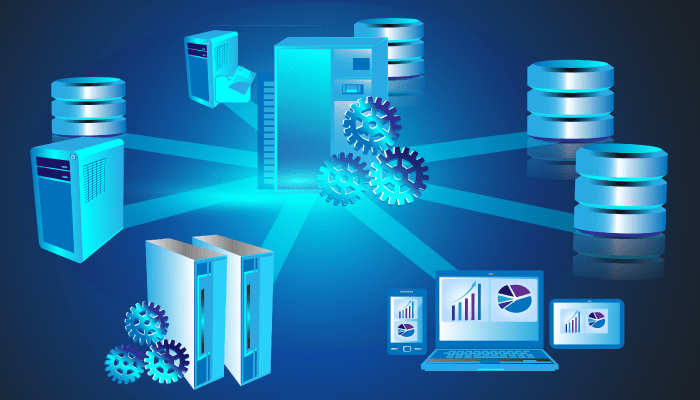
Introduction: In today’s data-driven world, information has become a valuable asset for businesses and individuals alike. Managing and organizing vast amounts of data efficiently and securely is crucial for making informed decisions, gaining insights, and driving innovation. This is where databases play a vital role. In this blog post, we will explore the fascinating world of data and databases, understanding their importance, types, and the benefits they offer.
- Understanding Data: Data is the raw information that holds immense potential. It can take various forms, such as numbers, text, images, audio, and video. Data can be categorized into structured, semi-structured, and unstructured formats, depending on the organization and relationships between the elements.
- What are Databases? A database is a structured collection of data that is organized, stored, and managed to facilitate efficient data retrieval, manipulation, and analysis. Databases provide a centralized repository for storing and accessing information, ensuring data integrity, and enabling concurrent data processing.
- Types of Databases: a. Relational Databases: Relational databases store data in tabular form, using tables with predefined schemas, where relationships between tables are established through keys. They employ Structured Query Language (SQL) for querying and manipulating data.
b. NoSQL Databases: NoSQL (Not Only SQL) databases are designed to handle large volumes of unstructured or semi-structured data. They offer flexible schemas and horizontal scalability, making them suitable for handling diverse data types and high-velocity data.
c. Object-Oriented Databases: Object-oriented databases store data in the form of objects, allowing complex relationships and behaviors to be defined. They are well-suited for object-oriented programming languages and applications.
d. Graph Databases: Graph databases focus on modeling relationships between entities using nodes and edges. They excel in managing highly connected data, such as social networks or recommendation systems.
- Benefits of Databases: a. Data Integrity and Consistency: Databases enforce data integrity rules, ensuring that data remains accurate, consistent, and reliable. This is crucial for maintaining the quality of data over time.
b. Efficient Data Retrieval: Databases employ indexing and query optimization techniques, enabling fast and efficient retrieval of specific data based on user-defined criteria.
c. Scalability and Performance: Databases can handle large datasets and support high volumes of concurrent user requests, providing scalability and optimal performance even as the data grows.
d. Data Security: Databases offer robust security mechanisms, including authentication, authorization, and encryption, to protect sensitive data from unauthorized access.
e. Data Analysis and Insights: Databases enable data analysis through powerful querying and reporting capabilities, helping businesses uncover trends, patterns, and insights that can drive informed decision-making.
- Database Management Systems (DBMS): Database Management Systems are software applications that facilitate the creation, maintenance, and manipulation of databases. They provide tools for data modeling, data querying, transaction management, and administration of databases.
- Challenges in Database Management: a. Data Quality: Ensuring data accuracy, completeness, and consistency can be challenging, especially when dealing with large and diverse datasets.
b. Scalability and Performance: As data volumes and user demands increase, optimizing database performance and scalability becomes crucial to maintain efficient operations.
c. Data Security and Privacy: Protecting sensitive data from unauthorized access and complying with data privacy regulations pose ongoing challenges for organizations.
d. Data Integration: Integrating data from multiple sources and maintaining data consistency across different databases can be complex, requiring careful planning and implementation.
Conclusion: Data and databases are the foundation of modern information management and decision-making. They enable organizations to unlock the power of data, gain valuable insights, and achieve competitive advantages. Understanding the types of databases, their benefits, and the challenges involved in managing data is essential for businesses and individuals navigating the data-driven landscape. By harnessing the potential of data and leveraging effective database management strategies, we can unlock new opportunities and drive innovation in the digital era.


Nanotechnology Demystified – Cont’d
Nanotechnology which deals with the research and development of tech at the nanoscale. The nanoscale is so tiny that it demands really powerful microscopes to view and it takes computer modeling to experiment with this minute world. Applications of nanotech date as old as stained glass used in window art in cathedrals. Those windows are…

Nanotechnology Demystified Cont’d
Nanotechnology is an exploration of the world that is a billionth of a meter and a millionth of millimeter. Imagine that! You can’t right? It’s too small, we’ll let me help you with this analogy. Comparing a nanoparticle to a marble is like comparing the globe to a ball. You hair grows one nanometer every…

Nanotech Demystified: nanomaterials
Nanotechnology deals with the control of matter at a molecular or atomic level; a scale at which materials demonstrate properties they wouldn’t on a larger scale. Nanotechnology has applications in medicine, electronics and it also promises amongst many things a new frontier of engineering and material science. As mentioned entire the properties of materials differ…
 Fortizo Tech-hub
Leave a comment