Introduction
In a world where technology is constantly evolving, two remarkable innovations have captured our imagination and are reshaping the way we interact with the digital realm – Augmented Reality (AR) and Virtual Reality (VR). These cutting-edge technologies have found their way into various aspects of our lives, from entertainment and education to healthcare and beyond. In this blog post, we will delve into the realms of AR and VR, exploring their applications, impact, and the challenges they pose for the future.
Understanding AR and VR Technologies
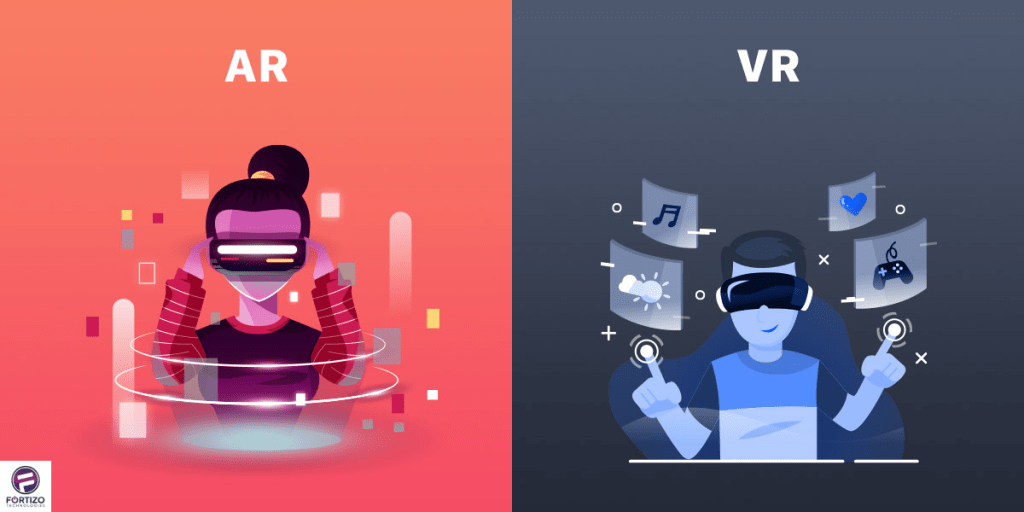
Augmented Reality (AR) seamlessly blends the physical and digital worlds, overlaying computer-generated content onto the user’s real-world environment. This technology enhances our perception of reality by adding contextual information, be it visual, auditory, or haptic, to our immediate surroundings. On the other hand, Virtual Reality (VR) immerses users in entirely virtual environments, shutting out the physical world to provide an all-encompassing digital experience. Both AR and VR technologies rely on powerful hardware and software to create realistic and captivating experiences.
Applications in Gaming, Education, and Healthcare
Gaming: AR and VR have revolutionized the gaming industry, giving players unprecedented levels of engagement. Augmented Reality games like “Pokémon GO” have encouraged players to explore their surroundings while interacting with virtual characters and objects. Virtual Reality, meanwhile, transports gamers into fully immersive worlds, providing an unparalleled sense of presence. Games like “Beat Saber” and “Half-Life: Alyx” have showcased the potential of VR gaming.
Education: AR and VR have breathed new life into the educational landscape. AR apps enable interactive learning experiences by overlaying relevant information on real-world objects. For instance, medical students can use AR to study the human body in 3D detail. VR, on the other hand, transports students to historical events, distant planets, or even the microscopic world, making learning engaging and memorable.
Healthcare: The medical field has embraced AR and VR for training, diagnostics, and patient treatment. Surgeons can use AR overlays during procedures to enhance accuracy, while VR simulations help medical professionals practice high-stress scenarios in a risk-free environment. VR has also proven effective in pain management and therapy, providing immersive distractions for patients undergoing treatments.
Challenges and Future Developments
Despite their incredible potential, AR and VR technologies face several challenges:
Hardware Limitations: High-quality AR and VR experiences demand powerful hardware, which can be expensive and inaccessible for some users.
Motion Sickness: VR-induced motion sickness remains a concern due to sensory conflicts between the virtual and physical worlds.
Content Creation: Developing compelling and realistic AR/VR content requires a unique skill set, and creating large-scale experiences can be time-consuming.
Ethical and Social Implications: Privacy concerns, digital addiction, and the blurring of real and virtual experiences raise ethical and social questions.
Looking ahead, several developments could shape the future of AR and VR:
Advancements in Hardware: Continued improvements in hardware will make AR and VR more affordable, lightweight, and accessible to a wider audience.
5G Integration: The rollout of 5G networks will enhance the quality and responsiveness of AR and VR experiences, enabling real-time interactions.
AI and Machine Learning: These technologies will play a significant role in enhancing object recognition, spatial mapping, and user interactions in AR and VR environments.
Collaborative Experiences: Future developments might focus on enabling multiple users to interact seamlessly in shared AR and VR spaces, revolutionizing remote communication and collaboration.
Conclusion
Augmented Reality and Virtual Reality have transcended their sci-fi origins to become integral parts of various industries. From revolutionizing gaming and education to transforming healthcare, their impact is profound. Challenges such as hardware limitations and ethical concerns will need to be addressed as these technologies continue to evolve. As we look to the future, the seamless integration of AR and VR into our lives holds the promise of unparalleled experiences limited only by our imagination.

Nanotechnology Demystified – Cont’d
Nanotechnology which deals with the research and development of tech at the nanoscale. The nanoscale is so tiny that it demands really powerful microscopes to view and it takes computer modeling to experiment with this minute world. Applications of nanotech date as old as stained glass used in window art in cathedrals. Those windows are…

Nanotechnology Demystified Cont’d
Nanotechnology is an exploration of the world that is a billionth of a meter and a millionth of millimeter. Imagine that! You can’t right? It’s too small, we’ll let me help you with this analogy. Comparing a nanoparticle to a marble is like comparing the globe to a ball. You hair grows one nanometer every…

Nanotech Demystified: nanomaterials
Nanotechnology deals with the control of matter at a molecular or atomic level; a scale at which materials demonstrate properties they wouldn’t on a larger scale. Nanotechnology has applications in medicine, electronics and it also promises amongst many things a new frontier of engineering and material science. As mentioned entire the properties of materials differ…

 Fortizo Tech-hub
Leave a comment